Discover Portbou
Walter Benjamin in Portbou: exile, memory and historical evidence
Walter Benjamin was born in Berlin in 1892 and died in Portbou on September 26, 1940, in the midst of fleeing Nazi-occupied Europe. This is the safe starting point. From here, his…
Source last checked: 30 September 2026
Walter Benjamin was born in Berlin in 1892 and died in Portbou on September 26, 1940, in the midst of fleeing Nazi-occupied Europe. This is the safe starting point. From here, his last journey, the circumstances of his death and subsequent memory require a distinction between institutional documentation, retrospective testimony and interpretation.
Portbou is not only the final place of a famous biography. It is also a space from which you can understand the Pyrenees border during the Second World War, the escape itineraries and the way Europe has built memory about exile. This is the editorial reading that guides the article.
The context: a border in times of persecution
The institutional sources agree on the general framework. Benjamin, a German philosopher of Jewish origin, was fleeing Nazism and trying to continue his journey to the United States. The Exile Memorial Museum places his arrival in Portbou at the end of September 1940, after having crossed the Pyrenees from France.
The Angelus Novus Foundation documents, based on the testimony of Lisa Fittko and her memorial publication, that Fittko guided Benjamin in the crossing of the Pyrenees on foot. The same source explains that Benjamin was traveling with Henny Gurland and his son Joseph and that the route followed a mountain path that Fittko had met through the mayor of Banyuls, Vincent Azéma.
It is important to label the source here: this detailed account of the crossing is retrospective testimony. Fittko’s memoirs are a central source for reconstructing the passage, but they are not an administrative record written on the same day. That is why the article will not present every detail of the narrative as if it were a contemporary record of the events.
The Banyuls–Portbou route has since become a memorial route. The material from the Municipal Tourism Office indicates that the currently signposted trail follows the escape route associated with Benjamin, and the MUME continues to organize activities along this route as part of the memory and exile programs.
The death in Portbou: what we can affirm and what should be clarified
The Portbou City Council dates Benjamin’s death to September 26, 1940. His municipal biographical sheet says that he supposedly committed suicide with an overdose of morphine after learning that he had to be repatriated, and adds that the circumstances of his death were surrounded by enigmatic elements.
The MUME presents the consolidated interpretation according to which, upon learning that the Spanish authorities intended to return him to Vichy France and that he could not continue to the United States, Benjamin committed suicide in the hotel where he was staying.
These two institutional sources do not force a choice between “absolute certainty” and “total mystery”. The most rigorous formulation is to say that the interpretation of suicide is widely accepted in the institutional memory, but that the City Council itself retains the qualifier “supposedly” when it talks about the specific mechanism of death. Badia Portbou will not present a dose, medical sequence or detailed psychological motivation as proven fact if we do not have sufficient primary documentation.
Nor will we make death the only center of the story. To do so would reduce Benjamin to a tragic episode and leave the context of persecution, the border and his work in the background.
The old Hotel de Francia and the urban trail
The municipal material of “Cultura de frontera” identifies the old Hotel de Francia, today privately owned, on Carrer del Mar, and points out that a plaque on the facade remembers that Benjamin died in that place.
This data allows the urban center to be included in the visit without transforming the building into a museum facility: it is a private property with a memorial function through the plaque. The distinction is important to avoid generating the expectation that the visitor will be able to enter.
The cemetery: memory, not a conventional grave
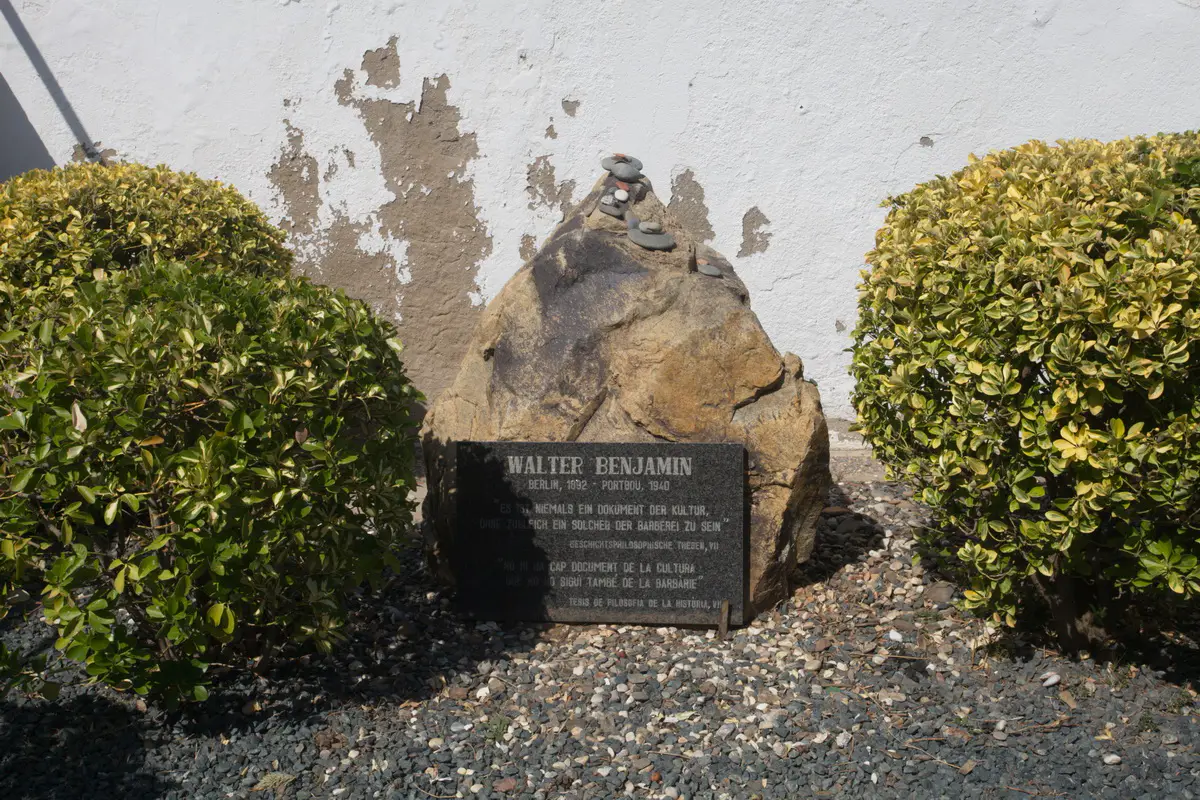
The Portbou cemetery contains several memorials dedicated to Benjamin. The municipal page of the cemetery mentions a stone with a plaque and a commemorative plaque at the entrance portal. The municipal brochure of “Cultura de frontera” also describes a symbolic tomb that receives offerings and plaques in memory of the philosopher.
The word symbolic is essential. We will not present this space to the visitor as if it were a fully identified conventional individual grave. The same municipal biographical sheet explains that the exact location of the grave was for some time a problem and places the body in the mass grave since 1945.
For the visit, this changes the way of looking at the cemetery: the interest is not to “find a famous grave” but to understand a set of memory marks built later. To read the space in its own history, beyond Benjamin, you can consult Portbou Cemetery: landscape, civil society, and memory.
Passages, by Dani Karavan
Next to the cemetery is Passages, the memorial dedicated to Walter Benjamin created by the Israeli artist Dani Karavan. The Angelus Novus Foundation places the inauguration on May 15, 1994 and explains that the work was promoted in the context of the fiftieth anniversary of Benjamin’s death.
The memorial is an intervention integrated into the landscape. The Foundation describes four elements of the set and highlights the stepped metal tunnel that descends towards the sea to a glass that interrupts the passage, as well as the stone wall and other elements arranged in the environment. The project physically relates landscape, border and memory.
There is no need to explain to the visitor what he “must feel” in front of the work. The most respectful interpretation is to provide the context and let the space work: descent, horizon, sea, limit and return.
The City Council published in 2017 that the Department of Culture of the Generalitat had approved declaring the Passages Memorial a Cultural Good of National Interest, in the category of historical site, and delimiting its protection environment.
This recognition helps to understand that Passages is not only a local commemorative piece, but a protected heritage asset.
From the memory of Benjamin to the memory of the exiles
The value of the Portbou set grows when Benjamin is not treated as an isolated case. The MUME uses its history to explain the role of the Pyrenean border during the Second World War and connects it to the context of Franco’s post-war and escape movements.
This expansion is consistent with the memorial itself: the Angelus Novus Foundation explains that Passages extends the tribute to the anonymous beings who flee into exile, not just to Benjamin.
This is also the reason why the touristic account of Badia Portbou will avoid a morbid approach. The site makes it possible to talk about rights, borders, persecution and European memory from a very specific geographical point.
A future project: the Walter Benjamin Memorial Space
This part needs absolute time precision. The Walter Benjamin Memorial Space in the old town hall is not, on September 30, 2026, an open museum that we can offer as a visit.
On May 18, 2026, the Plenary of the City Council definitively approved the rehabilitation and reform project of the old city hall to turn it into the Walter Benjamin Memorial Space. The municipal news of May 26 indicates that the City Council plans to start the works during the first semester of the following year.
The project’s public exhibition documentation explains that the building is designed to incorporate museum spaces dedicated to Walter Benjamin’s borders and, more broadly, to the borders of freedom and exiles, with temporary and permanent exhibitions.
This is an approved project, not a current service. Until the equipment is executed, open and with official visit information, Badia Portbou will keep it identified as a future project.
A memory that remains active
Portbou maintains a cultural activity around Benjamin. From September 25 to 27, 2026, the municipality hosted the XVIII Walter Benjamin International Colloquium, dedicated that year to Hannah Arendt; the program included a tribute to the cemetery and the Walter Benjamin Route between Banyuls and Portbou.
This data is useful not because we have to freeze a past event in the guide, but because it shows that the memory of Benjamin in Portbou is not only monumental. There is a cultural, academic and artistic program that has been renewed and that should be treated as a dynamic agenda, not as permanent content.
The Angelus Novus Foundation also announces guided tours of the Passages Memorial with reservation and activities linked to Benjamin. Since times, prices and conditions can change, the website will link to the current source instead of reproducing this data in a fixed way.
How to make a responsible visit
A consistent visit can link the old Hotel de Francia, the cemetery and Passatges, and book the Banyuls–Portbou mountain route for a specific day with the right preparation. To arrange the arrival, you can consult How to get to Portbou without a car. This proposal is editorial: it does not imply that all the points constitute a single official itinerary nor does it replace the technical information of the route.
The main criterion is not to confuse layers. Documented Fact: Benjamin escaped to Portbou and died there in September 1940. Testimony: Lisa Fittko left a pivotal retrospective account of the crossing. Institutional interpretation: suicide is the widely accepted reading, but the City Council itself remains cautious about the specific mechanism. Constructed memory: the cemetery, plaques and Passages are later ways of remembering those events. Future project: the new Memorial Space of the old town hall is not yet a visitable facility.
Maintaining these differences does not detract from the strength of the story. On the contrary: it allows Portbou to be read as a real place, with documents, testimonies, uncertainties and layers of memory, and not as a simplified legend for tourist consumption.
To expand the border context without mixing layers, The 1939 Retreat in Portbou and the Coll dels Belitres treats the Republican exile as its own episode. Portbou, a railway town and border town explains the railway infrastructure and chronology, while Portbou in one day integrates the memory spaces in a synthesis visit.