Discover Portbou
The 1939 Retirada at Portbou and Coll dels Belitres
The Coll des Belitres, between Portbou and Cervera de la Marenda (Cerbère), is today a road and hiking trail with open views over the Mediterranean. February 1939, however, was…
Source last checked: 7 October 2026
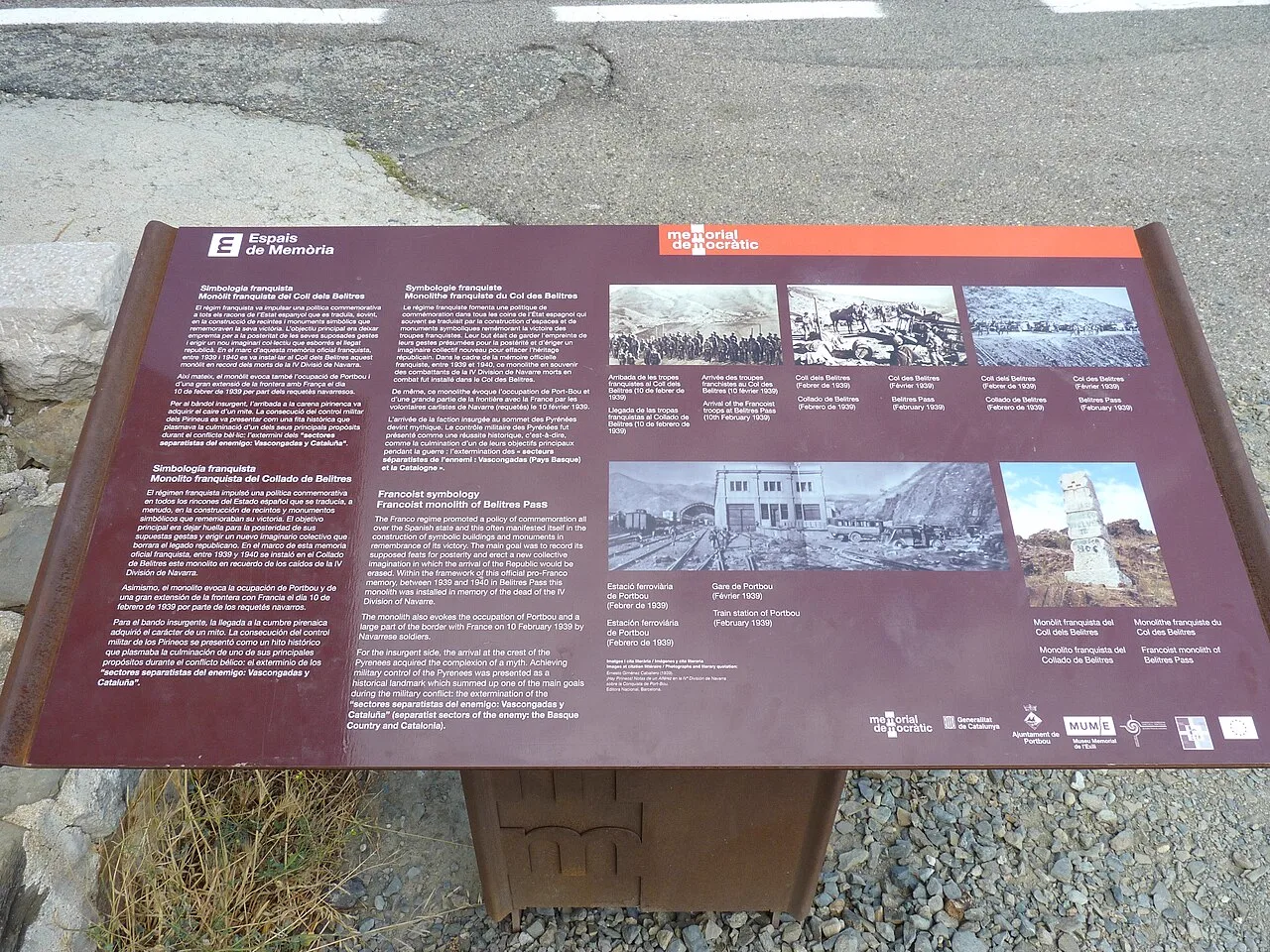
The Coll des Belitres, between Portbou and Cervera de la Marenda (Cerbère), is today a road and hiking trail with open views over the Mediterranean. February 1939, however, was one of the great crossing points of the republican exile. To read this landscape without this historical layer is to miss an essential part of what the Portbou border means.
La Retirada: an exodus of hundreds of thousands of people
With the fall of Barcelona and the final advance of Franco’s troops, the French border was opened at the end of January and beginning of February 1939. The Democratic Memorial places between 470,000 and 480,000 the people who left Spain in that great exodus.
The MUME often uses an approximate figure of half a million to explain the entirety of the Retreat. These data are general estimates of the exile movement, not the number of people who specifically passed through Portbou.
This distinction is important. The Belitres pass was one of the most used passes, but we do not have a unique and definitely established count for the Portbou pass in the sources consulted that would allow us to convert a local estimate into an exact figure.
Belitres: the border turned into a corridor of exile
The Democratic Memorial defines the Belitres pass as one of the main points of the Catalan Pyrenees used during the Retreat. Its location directly connects Portbou with Cervera de la Marenda and turns a border ridge into a human corridor towards France.
Geography helps to understand the hardness of the step. It is a territory exposed to the wind, with a slope and without the protection we would associate with an urban route. Today it can be toured with equipment, weather information and planning; the winter of 1939 was a journey of escape carried out in a context of war, fatigue, fear and mass displacement.
The photographs of Manuel MorosThe current memorial incorporates photographs taken by the painter and photographer Manuel Moros in February 1939. The Bank of Democratic Memory identifies them as a central part of the information set installed at the neck.
These images are of particular value because they do not represent a subsequent reconstruction. They are visual witnesses of the same episode of the Retreat and allow us to put faces, luggage and human movements to a story that, told only with numbers, can become abstract.
The memorial does not turn the pass into a closed museum: it places the documentation on the same landscape of the pass.
What was behind the border
Crossing into France did not mean reaching a stable or safe situation. The Democratic Memorial remembers that many of the people who crossed the Pyrenees ended up in French concentration camps. The MUME today articulates a cross-border memory network that connects the Alt Empordà passes with places like Argelers, Rivesaltes, Elna or Cotlliure.
This avoids telling Portbou as the end of the story. The Coll dels Belitres is a point in a much wider geography of exile.
1939 and 1940: two different directions
Portbou concentrates a particularly powerful historical paradox. In 1939, thousands of republicans flee towards the north, in the direction of France. A year and a half later, with France occupied or under the Vichy regime, other persecuted people try to cross the Pyrenees to the south to escape Nazism.
Walter Benjamin arrived in Portbou in September 1940 in this second context. Its history is not the same as the Republican Retreat, even if it shares a border, roads and landscape.
To dig deeper, Walter Benjamin in Portbou discusses his latest traverse and the memory built afterward.
E12, Ruta de la Retirada and memory: they are not the same
Today, different itineraries coincide or converge in some sections of the border. The European trail E12, the memorial paths and other local routes should not be presented as if they were a single historical route.Our guide From Cervera de la Marenda to Portbou via E12 expressly maintains this distinction. The current sports route can help to read the landscape, but it does not replace the signposting or the interpretation of memory spaces.
Visit the neck with context
The Belitres Pass Exile Memorial is free to visit according to the Democratic Memorial sheet. As access, road conditions and path conditions can change, it is advisable to consult current sources before considering a walking route.
Attitude also matters. It is an extraordinary vantage point over Portbou and the coast, but at the same time it is a place associated with a forced displacement of European dimensions.
There is no need to dramatize the landscape because the story is already strong enough. The photographs, the contextualized figures and the ridge itself explain why Portbou is one of the places where the European border of the 20th century can be read more directly.