Things to do
What to see in Portbou in one day
A day in Portbou gives enough scope to understand the main layers of the town if you don't try to turn the visit into a list of points to complete. The proposal is simple: start…
Source last checked: 30 September 2026
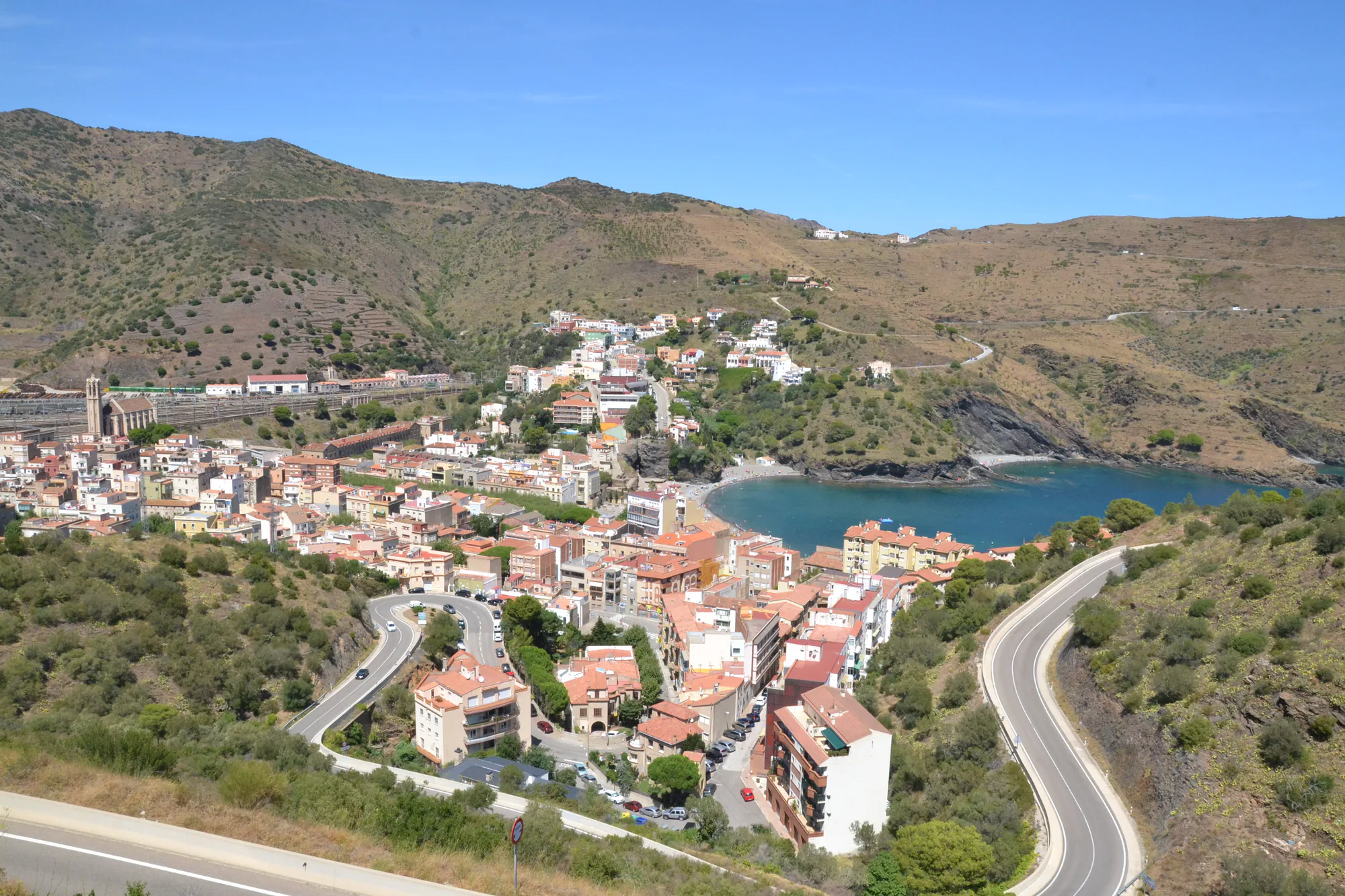
A day in Portbou gives enough scope to understand the main layers of the town if you don’t try to turn the visit into a list of points to complete. The proposal is simple: start with the territory, approach the sea, reserve space for the memory of Walter Benjamin and look at the station as an essential part of urban history. This sequence is editorial; it does not set hours or durations because the pace will depend on the arrival, the season and the conditions of the day.
Before coming, it is advisable to check How to get to Portbou without a car if the journey is by train. R11 and RG1 may have temporary changes, and timetables should always be checked on the official planners.
First: to be located between the Pyrenees and the sea
Portbou occupies the north-eastern end of the Alt Empordà, on the coastal part of the Albera mountain range. The immediate relationship between the ridge, the valley, the border and the Mediterranean explains much of the landscape that can be seen from the core itself.
Therefore, before looking for specific monuments, it is worth observing the shape of the place. The full story is at Portbou, where the Pyrenees meet the sea - it helps to understand why the border, the railway and the coast are so physically close together.
This first reading does not require any technical itinerary. It is simply a way of looking at Portbou: streets sandwiched between relief and sea, the station dominating part of the center and the open bay in front.
Go down to the waterfront
Platja Gran is the most urban beach in Portbou. The card of the Costa Brava Tourism Board Girona places it next to the promenade and the urban offer of the center. From this area, the circular path continues towards Platja Petita, les Tres Platgetes and Platja del Pi. In a one-day visit it is not necessary to assume that you have to get to the end of the route. You can decide on the ground how far to continue depending on the time available, the sea, the weather and personal conditions. The Beaches and resorts guide differentiates what we know about each space and which seasonal data - such as first aid or water quality - must be verified on the same day.
Les Tres Platgetes and Platja del Pi are accessible on foot and have a more natural environment than Platja Gran. This difference allows us to see, without leaving the coastal sector itself, how the urban coast gives way to a more rocky landscape.
Make time for Walter Benjamin
Portbou is not only understood from the sea. The death of Walter Benjamin in the town on September 26, 1940 and the memorial that has subsequently been built there form one of the most significant historical dimensions of the municipality.
A responsible visit can include the old Hotel de Francia - today private property and identified from the outside by a plaque -, the cemetery and the Dani Karavan Passages Memorial. The specific order is secondary; the most important thing is not to confuse the memorial spaces with a literal reconstruction of the events.
In the cemetery there are memorials dedicated to Benjamin and a symbolic grave; it should not be presented as a conventional fully identified individual grave. Next door, Passages is a memorial intervention integrated into the landscape and inaugurated in 1994.
In Walter Benjamin in Portbou we explain in more detail what is documented fact, what comes from Lisa Fittko’s retrospective testimony, and what corresponds to later memorial interpretations.
It is also necessary to maintain current accuracy: the future Walter Benjamin Memorial Space planned in the old town hall is a project approved in 2026, but is not yet a facility open to the public.
Watch the station with contextThe international station is not an addition to the town. The Railway history and border explains how this infrastructure transformed the development of Portbou and consolidated its border function. The documented chronology places the arrival of the first train in Portbou on January 20, 1878; the current building corresponds to a later phase, with the new station built in 1929.
In a short day there is no need to turn the station into an exhaustive visit. It is enough to understand its scale, the relationship with the relief and the fact that it remains an active railway infrastructure.
If you arrive by train, this reading is particularly natural: the very point of entry to the town explains part of its history.
A day without turning Portbou into a race
The common thread of this proposal is the proximity of different layers: landscape, coast, border, railway and memory. There is no “correct” time for each stop and no distance that needs to be completed to consider Portbou seen.
If the day is good, you can spend more time on the coast. If the weather is less inviting to the sea, the core, the station and the memory spaces allow a different reading of the municipality. This flexibility is an editorial recommendation, not an official tourism fact.
We also do not recommend chaining together long hiking routes in a single day. The technical sheets for the GR 92 from Portbou to Llançà, Cross-border E12 and Querroig circular list separately the layouts, gradients, warnings and, where applicable, return options.
For a first visit, the objective is more modest and more useful: to leave Portbou understanding why the town is at the same time Mediterranean, Pyrenean, railway and border.If the day ends at the station, the same journey back makes it possible to close the circle of the visit: the railway is no longer just transport and is related to the landscape and history that have been read during the day. It’s a way to give consistency to the route without adding an artificial stop.