Discover Portbou
Portbou: a railway town on the border
Portbou is an unusual case on the Catalan coast: the railway is not just a way to get there, but one of the infrastructures that explain why the modern center grew as it did. The…
Source last checked: 30 September 2026
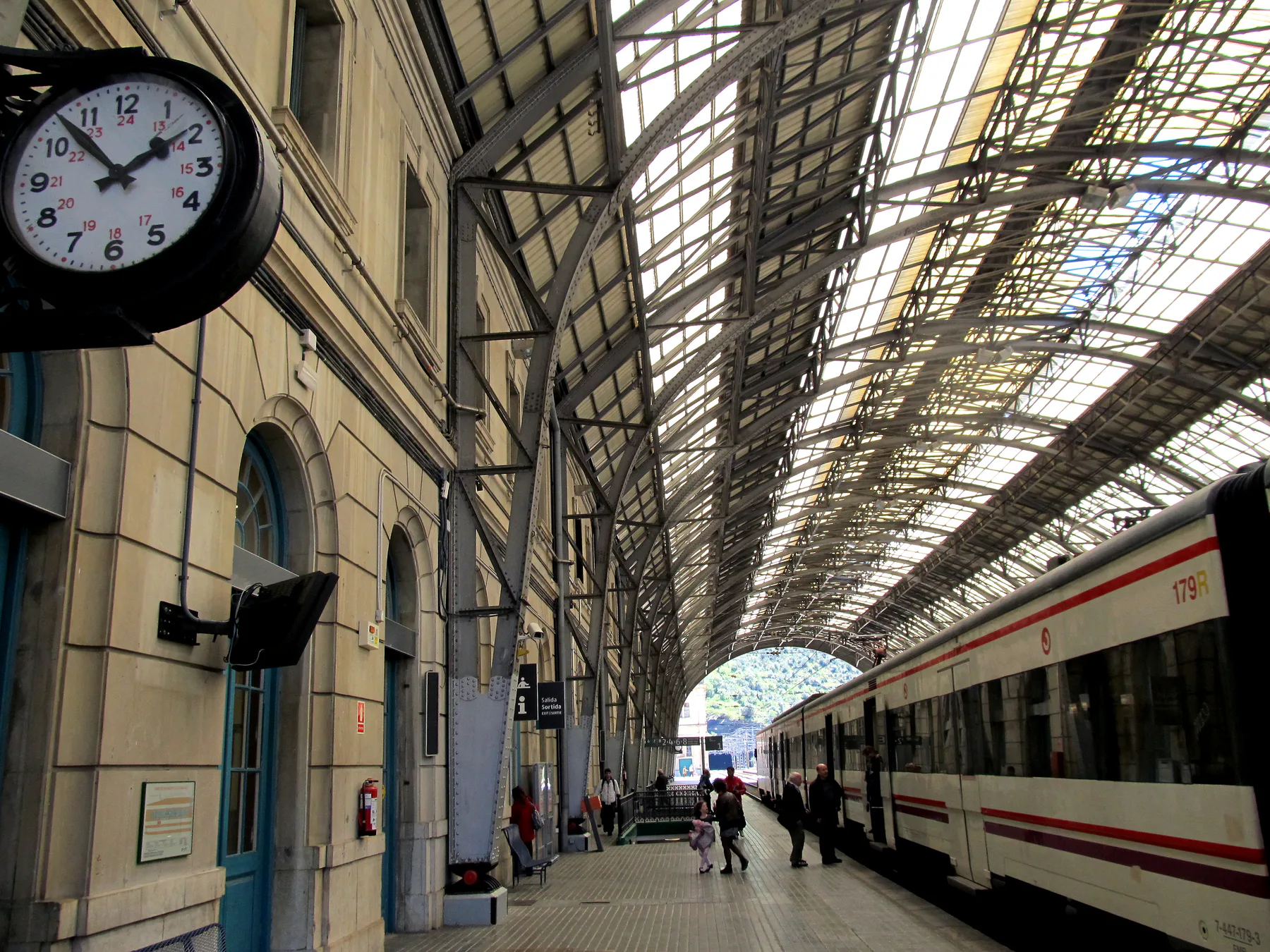
Portbou is an unusual case on the Catalan coast: the railway is not just a way to get there, but one of the infrastructures that explain why the modern center grew as it did. The City Council directly links the development of the town to the railway line and the international station, while the official history of the R11 places Portbou at the end of the process that connected Barcelona to the French border.
Understanding this story requires, however, resolving a discrepancy that appears in local sources: 1872 or 1878? The most solid documentary answer is 1878.
1872 or 1878: A discrepancy resolved
A municipal page on the origins of Portbou states that the opening of the railway line took place in 1872. This date contradicts the specific municipal chronology, the official history of Rodalies and contemporary railway documentation.
The City Council’s chronology indicates that in 1864 the Spanish-French agreement was made public that fixed the Belitres and Portbou pass as the border point of the future route. Rodalies places the creation of the Compagnia dels Ferrocarrils de Tarragona in Barcelona and France (TBF) in 1875 and explains that works towards France resumed from that moment. At the end of 1877 the line had reached Figueres; at the beginning of 1878, in Portbou and Cervera de la Marenda (Cerbère).
The municipal chronology is even more specific: on January 20, 1878, the first train arrived in Portbou and the Figueres-French border line was inaugurated. The data is consistent with the railway press of the same 20 January 1878, which already described coordinated services between Port-Bou and Cerbère, with Spanish trains arriving at the first French station and French trains entering Port-Bou.
There is another crucial archival piece. The Archivo Histórico Ferroviario preserves the agreement between TBF and the Compagnie du Midi for the operation of the Cerbère–Port-Bou connection line and the service relations between the two companies, dated June 21, 1878. Therefore, Badia Portbou will treat 1878 as the date of the arrival and opening of the Portbou railway. The reference to 1872 remains only as a detected documentary discrepancy, not as an equivalent historiographical alternative: we have found no primary or institutional railway source attesting to the arrival of the train at Portbou in that year.
Before the train: the border already determined the route
The railroad didn’t create the frontier, but it turned it into infrastructure. The municipal chronology recalls that the political limit to the north of the valley was already determined by the Treaty of the Pyrenees and that the Spanish-French railway agreement made public in 1864 placed the passage of the line through the Belitres pass.
This decision is essential to understanding the later Portbou. The route did not simply reach a coastal town: it had to link two state railway networks at a border point. This explains why the station, the tracks and the associated services acquired a disproportionate scale compared to the previous nucleus. The latter is an urban interpretation based on the chronology of local growth and documented frontier paper.
The landscape between Pyrenees and sea helps to physically understand this infrastructure: tunnels, ridge and coast condition the way the line enters the valley.
A railway border with two widths
The international character of Portbou is not only historical. The agreement published in 2020 between Adif and SNCF Réseau continues to define Cerbère–Portbou as one of the border railway sections between Spain and France. The document specifies that this section has tracks of two widths: standard and Iberian.
This coexistence responds to the historical difference between networks. There is no need to turn the article into an exhaustive technical explanation about rolling stock or maneuvers: for the visitor, the important fact is that the railway frontier still has a visible physical and operational expression in the infrastructure.Portbou station continues to be integrated into the Adif network. The current Adif file identifies station 79315 Portbou and maintains operational information. To check current passenger services, it is preferable to use the official planners we collect at How to get to Portbou without a car, rather than freezing timetables in a historical article.
From the first season to the 1929 set
The station that dominates the railway landscape today is not the original installation of 1878. The municipal chronology places the construction of the new station in 1929, coinciding with the year of the Barcelona International Exhibition. The municipal page dedicated to the station highlights the large iron and glass canopy and links it to the workshops of Joan Torras and Guardiola.
This change of scale is consistent with the consolidation of Portbou as an international point. The station was not only a place to pick up and drop off passengers: the border character required railway spaces and services specific to a connection between networks.
The municipal history of the station also allows the authorship to be fine-tuned. The marquee was built in the workshops of Joan Torras and Guardiola, but the City Council identifies Joan Deulofeu and Arquer as the true architect of the marquee project. Deulofeu worked at Torras Herreria y Construcciones and participated in other large metal structures of the time.
The same source highlights Eduard Maristany as one of the engineers linked to the final push for the railway connection in 1878 under the direction of Claudi Planàs. These biographies remind us that behind a monumental infrastructure there is also a network of engineers, entrepreneurs and specialized workshops.
To read the building rigorously, it is best to avoid two simplifications. The first is to confuse the current station with the first station of the line. The second is to turn the whole into a purely monumental piece: it remains a railway infrastructure in use.
The 20th century: integrate, electrify, modernizeThe official history of the R11 makes it possible to follow some structural transformations without going into an exhaustive chronology of each reform. At the end of the 19th century, the Portbou line was integrated into the MZA company; in 1941 it passed to the new state network RENFE.
Rodalies places the extension of electrification to Portbou in 1964 and the completion of the double track along the entire route in 1977.
These are technical changes, but they also explain a continuity: Portbou maintained a railway role for decades that is not limited to the inaugural moment in 1878. The current landscape is the result of successive phases of adaptation of the line, the station and the relationship with France.
Railway, border and memory
The railway infrastructure is also part of the political history of the 20th century. The very history of the R11 points out that during the Civil War the line was a vital link with France. Portbou, moreover, appears associated with exiles and border movements that today are explained from spaces of memory.
This layer can be deepened in Walter Benjamin in Portbou, where we separate the documented facts, the witnesses of the crossing and the memory constructed afterwards.
There is no need to present the station as the scene of all the border episodes or to attribute to it facts that are not documented. The relationship is broader: railway, border crossing and political history share the same territory.
How to watch the station today
A visit to Portbou allows you to read the station from two points of view at the same time. As a traveler, it is an active infrastructure connected to the regional network and to the Cerbère–Portbou border section. As a visitor, it is also a piece that helps explain the urban transformation of the municipality.
The contrast with the waterfront is particularly clear. Beaches and resorts guide shows how, a short distance from the railway hub, the landscape changes from the urban promenade to the promenade and a steeper coast. This proximity between roads, mountains and sea is one of the spatial singularities of Portbou.That is why the station is more interesting when it is not visited as an isolated object. It is part of a system: the relief of Albera, the border tunnel, Cerbère, the urban plot that grew with the railway and the immediate coastline.
A date we can set
After comparing the documentation, the editorial chronology is clear: 1864 sets the framework for the border layout; 1875 marks the business reorganization that resumes the works; end of 1877 they locate the railway in Figueres; January 20, 1878 is the documented date of the arrival of the first train in Portbou and the opening of the stretch to the border; June 21, 1878 already documents the exploitation relations between TBF and Midi; 1929 corresponds to the new station; and the 20th century brings electrification, double track and successive railway reorganizations.
This sequence allows one to rule out 1872 without replacing an error with an impromptu certainty. In a story so tied to the railroad, dates must follow the documents.