Discover Portbou
Santa Maria de Portbou: a church born with the railway
Santa Maria de Portbou is an unusual church because of its origins. It is not an ancient church in a medieval village that later gained a railway: it emerged alongside railway-era…
Source last checked: 7 October 2026
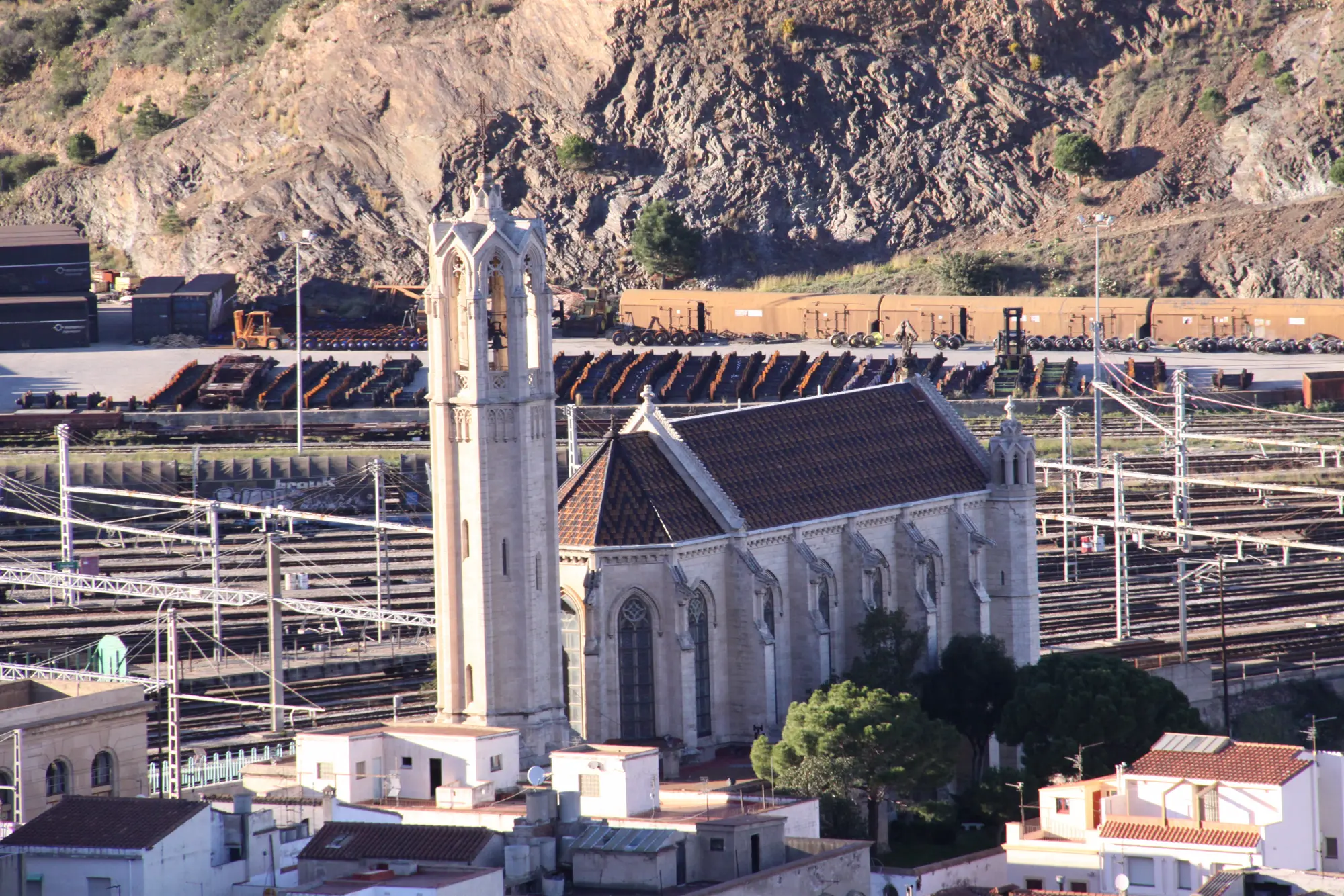
Santa Maria de Portbou is an unusual church because of its origins. It is not an ancient church in a medieval village that later gained a railway: it emerged alongside railway-era Portbou and stands on elevated ground beside the station and tracks.
1878 or 1879? A minor discrepancy in the sources
One section of the municipal website says that the railway company built the church “from 1878”. Its historical section, however, states that construction began in 1879, as does the official Portbou chronology.
For consistency, Badia Portbou uses 1879 as the start date, while acknowledging the municipality’s reference to 1878. The church was inaugurated two years later, according to the same parish and municipal source.
A church for a new railway town
The town council explains that the church was built on the station esplanade to meet the religious needs of railway workers living in Portbou. The municipal Cultura de frontera publication attributes the initiative to Claudi Planàs, a figure associated with the development of Catalonia’s railway lines.
The church’s history is therefore part of the railway story. As the station brought rapid population growth, new facilities were created for the emerging community.
That connection remains visible today: Santa Maria rises above the town, with tracks and railway buildings immediately around it.
Joan Martorell and the Gothic Revival
The architect was Joan Martorell i Montells (1833-1906), an important figure in nineteenth-century Catalan Gothic Revival architecture. The municipal source places him among the architects who worked before the rise of Modernisme and notes his professional links with Antoni Gaudí.
He designed a single-nave Gothic Revival church, aligned north to south. The council gives approximate dimensions of 33 metres in length, 8.5 metres in width and 20 metres in height.
The façade features pointed openings, columns and capitals, a large rose window and intricate decoration. The polygonal apse and decorative reliefs include representations of the sun and moon.
A bell tower separate from the church
One of the easiest features to recognise is the bell tower: an octagonal structure behind the apse, physically separate from the main church building. From different parts of Portbou, tower and church read as two parts of a single ensemble.
According to the municipal description, the present bells date from 1956 and are named Àngels, Eloïsa and Cecília.
Thirteen stained-glass windows and the local calendar
The interior has thirteen stained-glass windows between the buttresses. The municipal source says they were restored during the forties, with care taken to preserve the original colours and designs.
The apse features imagery of the Assumption of Mary, Sant Jaume and the Three Kings. These reflect the local calendar: Mary is the church’s dedicatee, Sant Jaume is the town’s patron saint, and the Three Kings are linked with a smaller winter celebration.
Frederic Marès returns to Portbou in his work
An image of the Immaculate Virgin on the altarpiece behind the altar is attributed to Frederic Marès i Deulovol, a sculptor born in Portbou in 1893.
The connection is particularly evocative: an artist born in the railway town of the late nineteenth century left a work in a church built for that emerging community.
Learn more in Frederic Marès: from Portbou to the world of collecting.
A building that helps explain Portbou
Santa Maria is significant beyond its religious purpose. It reveals the kind of town Portbou was becoming in the late nineteenth century: a rapidly growing community of railway workers, new services, landmark architecture and international infrastructure directly next door.
Wikimedia Commons identifies the church as a Cultural Asset of Local Interest (BCIL) and associates it with Catalonia’s Architectural Heritage Inventory.
Worship and visiting hours may change. Rather than provide a potentially outdated timetable, visitors should consult current municipal information before entering.