Discover Portbou
Portbou cemetery: landscape, civil society and memory
Portbou cemetery is internationally known for its association with Walter Benjamin and the nearby Passatges memorial by Dani Karavan. Yet it also has a history of its own,…
Source last checked: 7 October 2026
Portbou cemetery: landscape, civil society and memory
Portbou cemetery is internationally known for its association with Walter Benjamin and the nearby Passatges memorial by Dani Karavan. Yet it also has a history of its own, illuminating the emergence of modern Portbou, late nineteenth-century civil burial practices and the relationship between landscape and memory.
A cemetery built with modern Portbou
The municipal account states that the cemetery was built on land acquired by the railway company and completed in 1885.
That year was also when Portbou established its first municipal council, amid the growth brought by the railway.
Before Portbou had a cemetery of its own, burials took place in Colera. According to the municipality, the deceased were transported by sea: Portbou still belonged to the neighbouring municipality, and the modern coastal road did not yet exist.
This detail shows how recently much of the town’s everyday infrastructure appeared.
1899: Catholic and civil burial areas
In 1899 the cemetery was divided between a Catholic area and a civil burial area. The municipal source says the two were subsequently joined.
The distinction matters historically: religious rites and civil forms of burial coexisted.
This context can be considered alongside the documented presence of the Progrés Portbouenc Masonic lodge, without oversimplification. A civil burial area is not in itself proof of Masonic authorship, nor can every non-religious burial be attributed to that lodge.
Masonic symbols on gravestones
The municipal booklet Cultura de frontera reports that some gravestones preserve Masonic symbols, associated with the period when Progrés Portbouenc was most active.
The cemetery is therefore also an important record of late nineteenth-century society.
For more context, Freemasonry in Portbou explains what is known about the lodge and identifies discrepancies between local sources that should not be treated as established facts.
A cemetery facing the sea
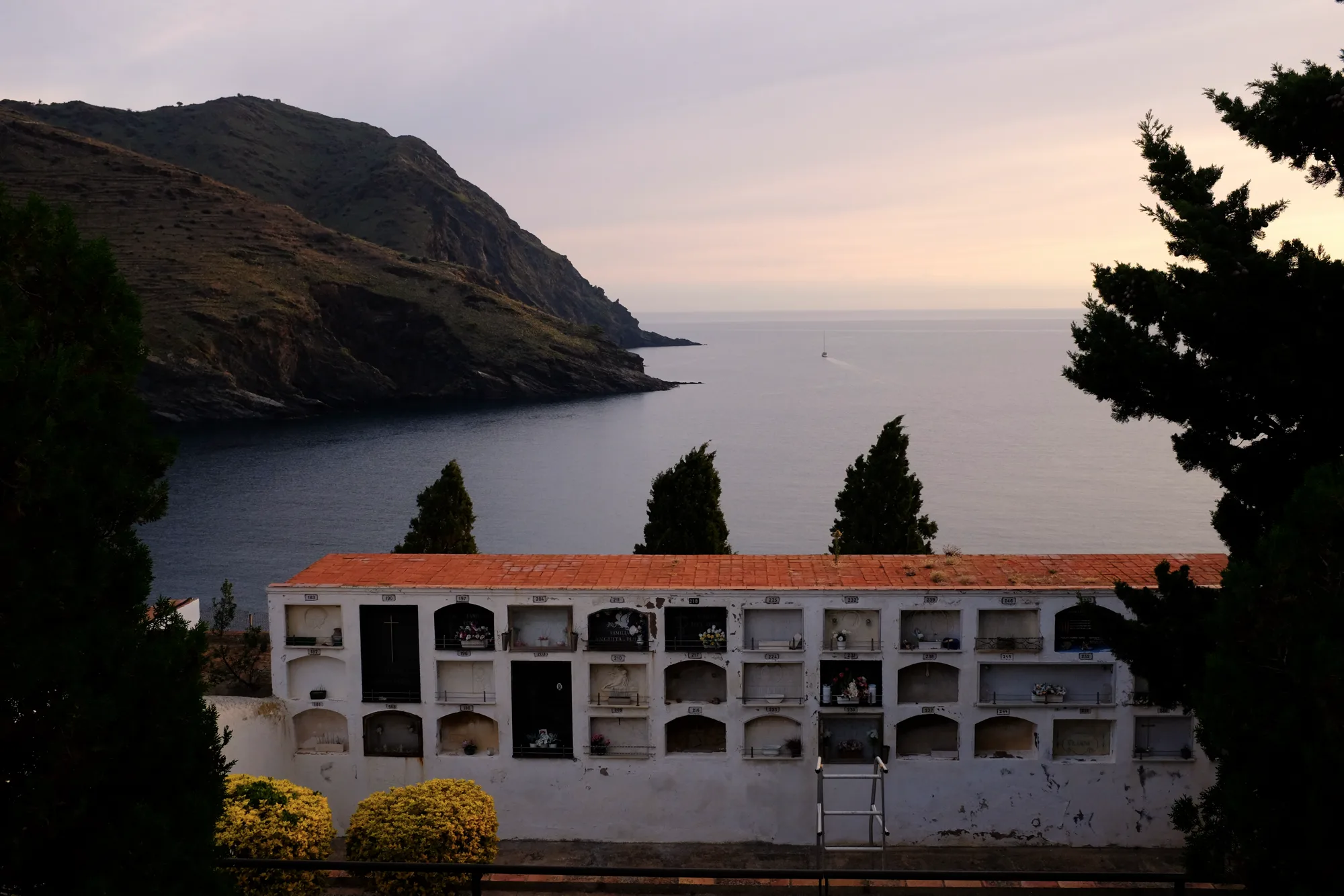
The cemetery stands at Punta del Caixol, on stepped terraces facing the Mediterranean. Local tourism sources describe this setting as particularly distinctive.
It is not merely picturesque. The sea and the terrain shape Portbou even in its burial grounds. The confined geography that accommodates railway tracks, homes and roads also pushes the cemetery onto elevated ground overlooking the coast.
Walter Benjamin: a later layer of memory
Inside the cemetery are commemorative features dedicated to Walter Benjamin. Municipal sources describe a stone with a plaque and other markers; Cultura de frontera also identifies a symbolic grave.
The word symbolic matters. As explained in Walter Benjamin in Portbou, this memorial should not be presented as an unequivocally identified conventional grave.
The twentieth-century remembrance is a later layer in a cemetery already half a century old.
Passatges is beside, not inside, the cemetery
Dani Karavan’s Passatges memorial is beside the cemetery, not within it. Their proximity creates a striking ensemble for visitors, but the two places have distinct histories and purposes.
A careful visit can distinguish three layers: the burial ground of modern Portbou, the social and Masonic history of the late nineteenth century, and later commemorations of Walter Benjamin.
Visiting respectfully
This remains an active burial ground, not a tourist set. Photography, the study of symbols and visits to memorial features should not interfere with funerals, ceremonies or family visits.
Such respect helps visitors appreciate the cemetery for what it is: a quiet archive of Portbou society, set in one of the town’s most distinctive landscapes.